

Choosing a preschool involves more than comparing locations, schedules, and classroom facilities. Parents may also encounter educational philosophies that shape how children learn and interact with their surroundings. Montessori and Reggio Emilia are two established approaches that emphasize curiosity, independence, and active learning, yet they organize educational experiences differently. Understanding their teaching methods, classroom environments, learning materials, and assessment practices can help families identify a preschool that aligns with their child's needs and their own educational priorities.
Different Origins, Different Educational Philosophies
Montessori education originated in Italy through the work of physician and educator Maria Montessori in the early 1900s. The approach views children as capable learners who develop independence through purposeful activities. Its curriculum follows a defined developmental progression, with children selecting work from carefully prepared materials suited to their abilities and interests.
Reggio Emilia emerged in postwar Italy and developed through the work of educator Loris Malaguzzi and the local community. It similarly treats children as capable participants in their education, but places particular emphasis on relationships, communication, and collaborative discovery. In the United States, families can find Reggio Emilia-inspired preschools, although these programs operate independently and are not officially certified by the Italian educational movement.
A comparison of these educational philosophies highlights their shared respect for children's abilities alongside important differences in how learning is organized.
Montessori Uses a Structured Learning Environment
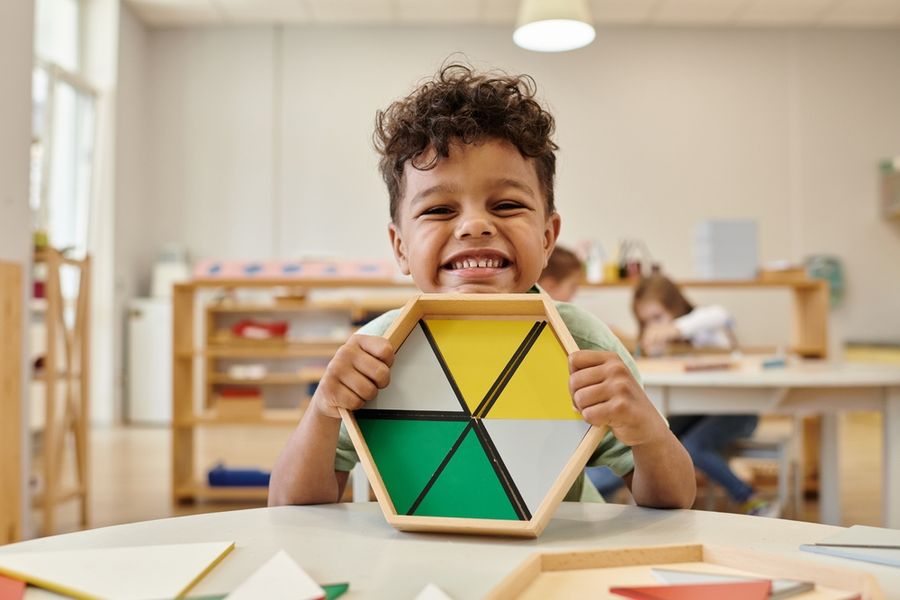
Montessori classrooms are carefully arranged to encourage children to select activities and complete them independently. Low shelves display specialized educational materials, while child-sized furniture makes the environment accessible. Classrooms commonly include practical life, sensory, language, mathematics, and cultural learning areas.
The Montessori prepared environment emphasizes freedom within clear boundaries. Children choose activities from available materials, while educators introduce new exercises when students demonstrate readiness. A preschooler might practice pouring water, arranging number rods, or matching textured objects. Each exercise has a particular educational purpose, allowing children to develop skills through repetition and hands-on exploration.
Reggio Emilia Follows Children's Emerging Interests
Reggio Emilia classrooms tend to organize learning around questions and interests that develop through children's experiences. Rather than following a fixed sequence of specialized materials, teachers observe students' interests and develop projects that encourage further investigation.
For example, children fascinated by shadows might spend several days exploring light, drawing shadow shapes, experimenting with transparent materials, and discussing their observations. The Reggio Emilia approach emphasizes experimentation, creativity, relationships, and collaboration. Projects may evolve as children develop new questions, allowing investigations to take directions that educators did not anticipate when the activity began.
Learning Materials Serve Different Purposes
Montessori classrooms use specialized educational materials designed to develop particular skills. Examples include movable alphabet letters, counting beads, geometric solids, and practical life tools. Children often repeat exercises independently until they gain confidence or master a concept.
Reggio Emilia environments offer a broader collection of open-ended materials. Children might explore clay, paint, wire, fabric, recycled objects, natural materials, and light tables. These resources invite experimentation rather than directing students toward one predetermined outcome. The distinction is not that Montessori excludes creativity or that Reggio Emilia lacks educational structure. Instead, Montessori typically emphasizes progressive skill development, while Reggio Emilia places greater weight on investigation and expressive possibilities.
Teachers Guide Learning in Different Ways
In Montessori education, teachers are often called guides because they observe children's development, introduce appropriate materials, and support independent activity. Rather than directing every moment, educators allow students to concentrate on selected tasks. The Montessori early childhood model incorporates extended, uninterrupted work periods that allow children to explore activities at their own pace.
Reggio Emilia teachers also observe carefully, but frequently participate as collaborators in children's investigations. They encourage discussion, document questions, introduce materials, and help students explore emerging ideas. This approach often includes sustained group projects where children share interpretations and negotiate solutions. Both philosophies value teacher guidance, although the balance between individual exploration and collaborative investigation differs.
Social Interaction and Classroom Organization
Montessori preschools commonly use mixed-age classrooms, often bringing together children approximately ages three through six. Younger students can observe more experienced classmates, while older children have opportunities to demonstrate skills and offer assistance. Independent work remains important, but collaboration and peer learning are also encouraged.
Reggio Emilia places particularly strong emphasis on relationships among children, teachers, and families. Group investigations allow children to exchange ideas, consider different viewpoints, and develop shared projects. The comparative research on early childhood education models identifies collaborative projects and community involvement as distinctive characteristics of this philosophy. However, actual classroom arrangements vary, and families should observe how individual schools encourage social development.
How Each Approach Documents Learning
Neither philosophy relies primarily on conventional written examinations for young children. Montessori teachers typically assess development through systematic observation, noting how children use materials, demonstrate new abilities, and progress toward individual learning objectives.
Reggio Emilia places particular importance on pedagogical documentation. Teachers collect photographs, children's artwork, recorded conversations, and other evidence of learning. These records help children revisit their discoveries and allow families to understand how projects develop. Documentation becomes part of the educational experience itself, rather than functioning only as a record of completed work.
Choosing the Preschool That Fits Your Child
Montessori and Reggio Emilia share a belief that children learn through active exploration, meaningful experiences, and respectful guidance. Montessori offers a recognizable progression of learning materials and opportunities for independent concentration, while Reggio Emilia emphasizes collaborative investigations, creative expression, and developing children's interests.
Families should visit prospective schools, observe classroom activities, and ask how teachers support individual needs. It is also important to examine educator qualifications, daily routines, and opportunities for parent involvement. Because schools may interpret these philosophies differently, the program's actual practices matter more than its label. The strongest choice is an environment where children receive thoughtful guidance, appropriate challenges, and opportunities to develop confidence as learners.