

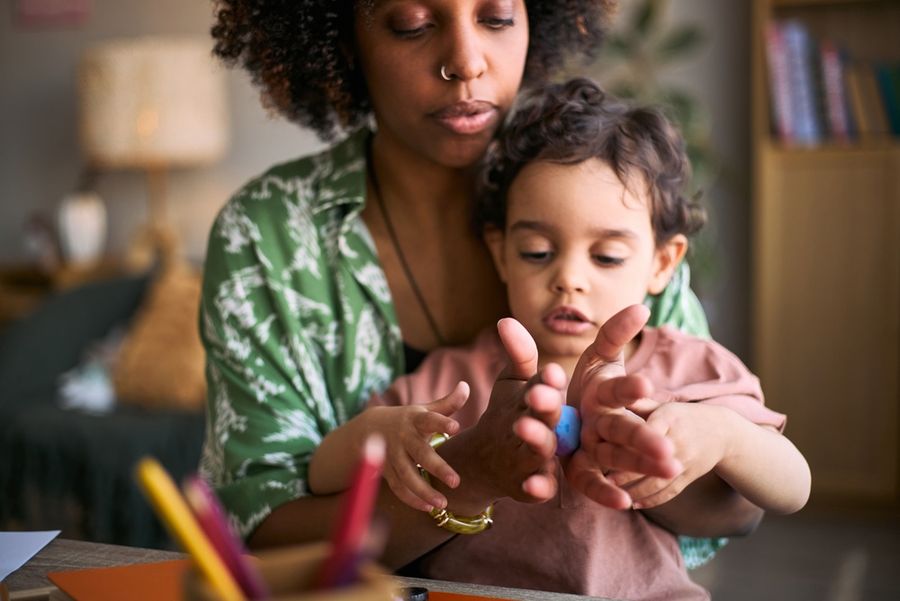
Art activities offer preschoolers an enjoyable way to navigate early mathematics without relying on worksheets or formal instruction. By arranging paper shapes, making prints, and experimenting with three-dimensional materials, children can learn how objects relate to one another in space. Several creative experiences introduce concepts such as symmetry, position, rotation, and geometric composition. With simple supplies and age-appropriate guidance, parents and educators can turn familiar art projects into opportunities for developing spatial reasoning and mathematical understanding.
1. Create Geometric Collages With Paper Shapes
A shape collage introduces preschoolers to geometry through creative arrangement. Prepare large paper circles, squares, rectangles, and triangles in different colors and sizes. Give each child a sheet of construction paper and invite them to create a picture using the shapes. They might arrange triangles into mountains, combine rectangles into buildings, or use circles to represent flowers.
Before gluing, encourage children to experiment with different positions and combinations. The Shape Collage activity explores how arranging, overlapping, and positioning geometric pieces can create recognizable images. Ask children whether their shapes are beside, above, or underneath one another. These conversations introduce spatial vocabulary while allowing children to make independent artistic decisions.
2. Discover Symmetry Through Butterfly Painting
Butterfly painting provides a simple introduction to symmetry, the relationship between parts of a figure that match across a dividing line. Fold a sheet of paper vertically, reopen it, and help children place several small spots of washable paint on one side. Fold the paper again, gently press the two halves together, and unfold it to reveal the resulting pattern.
Ask children to examine the shapes and colors on either side of the crease. Which markings appear in corresponding positions? Are the two halves exactly alike? Preschoolers can explore symmetry further by drawing a line down the center of a paper butterfly and decorating one wing before creating a similar design on the other. The goal is to introduce the idea of reflection rather than expect perfectly balanced artwork.
3. Make Shape Prints With Everyday Objects
Printmaking helps children discover the connection between three-dimensional objects and the flat shapes they leave behind. Gather large, clean household objects, including cardboard tubes, rectangular blocks, and plastic containers. Place washable paint in shallow trays and provide sheets of sturdy paper. Invite children to dip the objects into paint and press them onto the paper.
Children may discover that the circular end of a tube produces a round print, while the flat face of a rectangular block creates a rectangle. The preschool shape exploration approach includes making prints with three-dimensional objects to investigate their flat surfaces. Encourage children to predict each print before testing it, then arrange repeated impressions into an original design. Use smooth, unbreakable materials and supervise paint activities.
4. Build Pictures With Tangram-Style Shape Puzzles
Tangram-inspired art challenges children to combine smaller shapes into larger pictures. Prepare oversized paper triangles, squares, and parallelograms, or use a child-friendly geometric puzzle set. Begin by showing children how two triangles can be arranged to form a larger figure. Then invite them to create houses, boats, animals, or imaginary characters.
Unlike a collage, which emphasizes creative placement, this activity focuses on fitting pieces together and changing their orientation. The geometry and spatial reasoning activities explain how turning, flipping, and sliding shapes can support children's understanding of spatial transformations. Ask preschoolers to describe their movements: Did they rotate a triangle, slide a square, or flip a piece to make it fit? Older children can attempt simple silhouettes using a limited collection of shapes.
5. Sculpt Three-Dimensional Shapes With Modeling Clay
Modeling clay introduces preschoolers to the difference between flat geometric figures and solid objects. Provide soft, child-safe clay or homemade modeling dough and invite children to roll spheres, flatten circles, and shape cylinders. Encourage them to investigate how the materials change when squeezed, stretched, or pressed.
Children can combine their creations into sculptures, such as a robot made from cylinders and rounded forms. The everyday shape exploration activities include manipulating dough to create geometric figures and solids. Ask children which pieces roll, which stack easily, and how the shapes fit together. They can also examine their sculptures from different viewpoints, noticing how an object may appear different when viewed from above or from the side.
Helping Creativity Strengthen Early Math Skills
Art activities can introduce preschoolers to mathematical ideas through enjoyable, hands-on experiences. Collages encourage positional awareness, butterfly paintings explore reflection, and printmaking connects solid objects with flat shapes. Tangram puzzles develop spatial visualization, while clay modeling helps children investigate three-dimensional forms.
Parents and educators can strengthen these experiences by asking children to describe what they are creating and how they arrange materials. Instead of emphasizing a perfect finished product, encourage experimentation, revision, and independent choices. When children discover that shapes can be combined, rotated, reflected, and transformed, art becomes a practical introduction to the spatial reasoning skills that support later mathematical learning.