

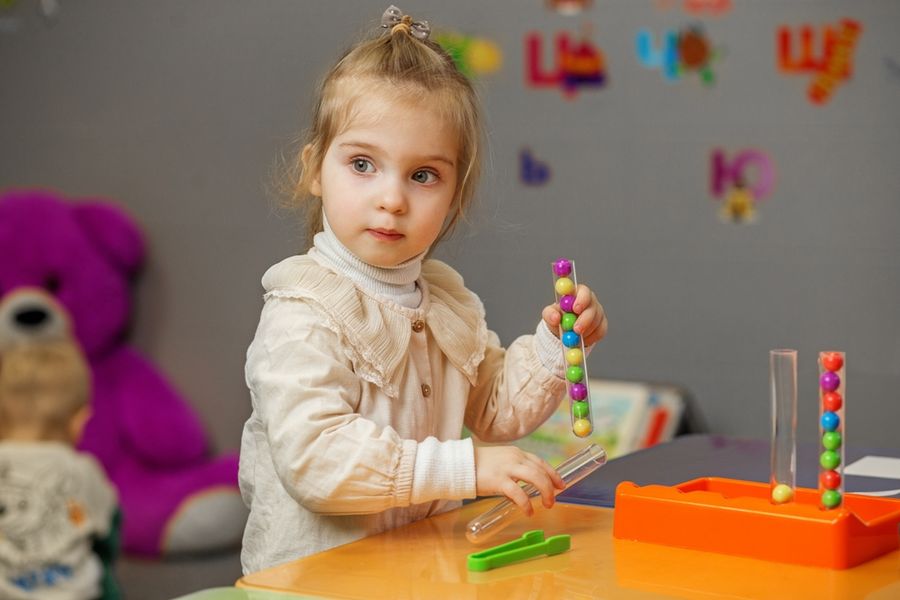
Sorting is one of the earliest mathematical skills children can practice, often without realizing they are learning. When preschoolers organize toys, separate clothing, or group objects by color, they begin recognizing similarities and differences. Such experiences introduce classification, the process of arranging objects according to shared characteristics. With a few familiar materials and thoughtful questions, parents and educators can turn everyday sorting into enjoyable learning opportunities that develop observation, reasoning, vocabulary, and foundational mathematical understanding.
1. Create a Color Sorting Station With Building Blocks
Building blocks provide an accessible introduction to classification because children can easily identify their colors. Gather a collection of large blocks in several colors, along with three or four containers. Invite preschoolers to place matching colors together, creating separate groups of red, blue, yellow, or green blocks.
Once the blocks are organized, ask children to explain how they decided where each piece belonged. Next, introduce a few blocks in unfamiliar colors and encourage them to create new categories. The early mathematics approach to classification emphasizes sorting by one characteristic at a time, making color an appropriate starting point.
For an additional challenge, introduce blocks with different shapes and ask children to reorganize their collection. Discovering that the same objects can be grouped in different ways introduces flexible mathematical thinking.
2. Organize a Pretend Grocery Store
A pretend grocery store encourages preschoolers to classify objects according to their purpose rather than their appearance. Gather empty, clean food containers or large toy groceries and arrange several labeled baskets around a table. Possible categories include fruits, vegetables, canned foods, and refrigerated products.
Invite children to pretend they are grocery workers organizing a delivery. Ask them to explain why certain products belong together. The sorting and classifying activities include grouping groceries according to where they should be stored, such as cupboards, refrigerators, and freezers.
Once everything is organized, change the classification rule. Children might separate foods that need cooking from those that can be eaten without preparation. This demonstrates that grouping decisions can depend on the question being investigated.
3. Sort Natural Materials by Texture and Appearance
Outdoor exploration offers opportunities to discover differences among natural objects. Collect several large fallen leaves, smooth stones, pinecones, and small branches from a safe outdoor area. Place them on a table and encourage children to examine their characteristics before organizing them.
Begin by asking preschoolers to separate objects according to texture. They might create groups containing smooth, rough, and bumpy materials. The Sort It Out activity encourages children to consider characteristics such as shape, texture, weight, and color when organizing collections.
Afterward, ask children to sort the objects again according to their appearance or type. A leaf that was previously grouped with smooth stones might now belong with other leaves. This demonstrates that one object can share different characteristics with several groups.
4. Build a Clothing Classification Game
Sorting clothing introduces classification through materials children encounter daily. Gather clean socks, shirts, hats, and mittens, preferably in several colors and sizes. Spread them across a table and invite preschoolers to organize the items into categories.
Begin with a familiar rule, such as grouping clothes according to where they are worn on the body. Next, ask children to distinguish clothing suitable for warm weather from items commonly worn during winter. Some pieces may fit more than one category, providing opportunities for discussion.
For a more challenging variation, ask children to sort clothing by two characteristics. For example, they might identify blue shirts or large socks. The classification activities for preschool mathematics explain how young children gradually progress from sorting by one characteristic toward considering multiple attributes.
5. Play a Mystery Sorting Rule Game
This activity challenges children to discover an organizing principle rather than simply follow instructions. Gather large geometric shapes that differ in color, size, and form. Without explaining your rule, arrange several shapes into two groups.
For example, place all triangles on one side of the table and squares on the other. Ask children to observe the groups and identify what the objects have in common. The Guess My Rule activity uses this approach to encourage children to identify geometric properties and explain classification decisions.
Once children understand the game, let them create their own secret rules. A preschooler might organize shapes according to the number of sides or separate large objects from small ones. Classmates can then examine the arrangements and explain their guesses.
6. Create an Animal Habitat Sorting Challenge
Animal classification introduces preschoolers to the idea that groups can be based on meaningful relationships rather than visible characteristics alone. Gather large animal figures or picture cards featuring familiar animals, such as fish, birds, bears, and frogs.
Prepare three spaces representing land, water, and air. Invite children to place each animal in the area where it usually lives or moves. The Speed Sorting activity includes animal grouping based on habitats and other characteristics.
Some animals will challenge simple categories. Ducks, for example, can swim, walk, and fly. Rather than insisting on one answer, ask children to explain their reasoning. For an additional activity, reorganize the animals according to whether they have feathers, fur, or scales. This introduces the possibility of classifying living things using different scientific characteristics.
Helping Preschoolers Recognize Patterns in Everyday Objects
Sorting activities introduce foundational mathematical reasoning by encouraging children to identify shared characteristics and explain their decisions. Building blocks develop color recognition, grocery activities introduce functional categories, and natural materials encourage close observation. Clothing, geometric shapes, and animal figures extend classification into increasingly complex relationships.
Parents and educators can support these skills by beginning with familiar categories before introducing more challenging rules. Encourage children to describe their groups, reconsider their choices, and experiment with different arrangements. The goal isn't simply to place every object correctly, but to develop an understanding of why objects belong together. Through repeated exploration, preschoolers can build classification skills that support later learning in mathematics, science, and everyday problem-solving.