

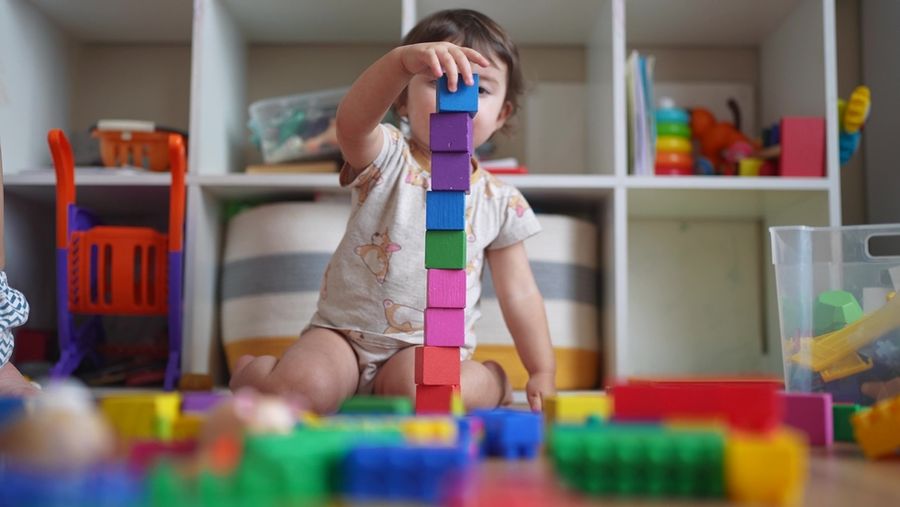
Preschoolers are natural problem-solvers, often experimenting with blocks, containers, and everyday objects to discover how things work. Simple engineering challenges can build curiosity by encouraging children to design structures, test ideas, and improve their creations. Several hands-on activities introduce foundational STEM concepts without requiring expensive equipment or complicated instructions. With common household or classroom materials, parents and educators can help young learners investigate balance, movement, strength, and construction while developing creativity and practical problem-solving skills.
1. Build a Block Tower That Won't Fall Over
Building a tower introduces preschoolers to balance, stability, and structural design. Gather large wooden blocks, cardboard boxes, or other stackable materials and challenge children to construct the tallest tower they can. Encourage them to experiment with different arrangements rather than demonstrating one correct method.
Once a tower is standing, ask children to observe its shape. Is the base wider than the top? What happens when larger blocks are placed higher up? The Building Block Towers activity explores how different arrangements affect stability. Preschoolers can investigate these relationships by comparing a narrow tower with one that has a broader foundation.
Extend the challenge by asking children to create a tower capable of holding a lightweight stuffed animal. If the structure collapses, encourage them to identify where it became unstable and try another arrangement. This introduces the idea that successful engineering often involves testing and improving an initial design.
2. Construct a Paper Bridge That Supports Weight
A paper bridge challenge demonstrates how ordinary materials can become stronger through thoughtful design. Place two sturdy blocks approximately six inches apart and give children a sheet of construction paper to connect them. Ask whether their bridge can support a small toy placed in the center.
Begin with a flat piece of paper and observe what happens when weight is added. Next, help children fold the paper into an accordion shape and test it again. The paper bridge experiment demonstrates how changing a bridge's structure can affect the weight it supports.
Students can compare different designs, recording how many identical lightweight objects each bridge holds. Introduce words such as support, strength, and structure during the investigation. The goal isn't necessarily to construct the strongest bridge, but to help children recognize that altering a design can change its performance.
3. Design a Ramp That Moves a Toy Car
Ramps provide an approachable introduction to motion, gravity, and inclined surfaces. Gather cardboard, books, blocks, and a large toy car. Ask children to construct a ramp that allows the car to travel from an elevated surface to the floor without falling off the sides.
Begin with a gentle slope, then experiment with raising or lowering one end. Children can observe how changing the ramp's angle influences the car's movement. The friction racing activity provides a useful extension involving different surfaces and their effects on moving objects.
For an additional engineering challenge, invite children to create a ramp with a turn or landing area. They might add cardboard barriers to keep the car on course or adjust the slope to prevent it from moving too quickly. Encourage them to predict what will happen before each test and explain which changes helped their design function.
4. Create a Boat That Can Carry Cargo
Designing a floating boat introduces preschoolers to buoyancy, balance, and the relationship between shape and function. Provide aluminum foil, a shallow container of water, and several identical lightweight counters. Challenge children to construct a boat that can carry the counters without sinking.
Start by shaping a small foil boat with raised edges. Place it in the water and gradually add the counters, keeping track of how many it supports. Children can then experiment with making the boat wider, changing its sides, or distributing the cargo differently. The foil boat investigation offers additional ways to explore how boat design affects carrying capacity.
Ask children why they think one design holds more cargo than another. They don't need to understand advanced physics to begin recognizing useful relationships. An adult should supervise all water activities and use large, age-appropriate objects rather than small items that could create choking hazards.
5. Engineer a Water Transportation System
Moving water from one location to another introduces preschoolers to a practical engineering problem. Set up two shallow containers at different heights and provide wide plastic tubing, funnels, flexible channels, or short sections of toy guttering. Challenge children to design a pathway that transfers water from the higher container into the lower one.
Begin by letting children explore the materials and determine how the pieces might connect. They can then test their arrangement using small amounts of water. If water spills or stops flowing, ask them to investigate whether changing the slope or adjusting a connection might solve the problem.
Preschool engineering design activities can involve real-world challenges such as transporting water across a playground. This project introduces similar concepts on a smaller scale. It also encourages cooperation as children propose designs, share materials, and revise their solutions. Use smooth-edged components and supervise the activity closely.
Helping Young Engineers Learn Through Experimentation
Engineering challenges are especially valuable when children have opportunities to make decisions rather than simply follow instructions. Building towers, strengthening bridges, adjusting ramps, designing boats, and transporting water each introduce different STEM concepts through active exploration.
Parents and educators can support learning by asking open-ended questions, encouraging predictions, and allowing children to revise unsuccessful designs. Rather than correcting every mistake, give preschoolers time to discover what works and explain their observations. These experiences help establish an early understanding of engineering as a creative process involving curiosity, experimentation, and improvement.